Hazel Scott Was One Of The Biggest Stars Until She Fought Racism
BOSSIP’s Black History Hidden Gems: Piano Prodigy Turned TV Trailblazer Hazel Scott Was Blacklisted For Battling Racism
Welcome back to the next chapter of BOSSIP’s Black History Hidden Gems, our weekly Black History Month series dedicated to uncovering overlooked Black figures, moments, and milestones. This series spotlights stories that history nearly erased, but legacy refused to forget.
Recognizing Black achievement during Black History Month is not only about honoring triumph, but about reclaiming narratives of resilience, intellect, and humanity that were, in some cases, deliberately buried. Visionary virtuoso Hazel Scott’s talent blazed trails across Broadway, film, and her own landmark TV show before Oprah was even born. Yet her name isn’t remembered with peers like Ella Fitzgerald and Lena Horne. Scott’s epic career was cut short for confronting Hollywood and the U.S. government about segregated crowds, racist portrayals of Black people, and political persecution a decade before the Civil Rights Movement.
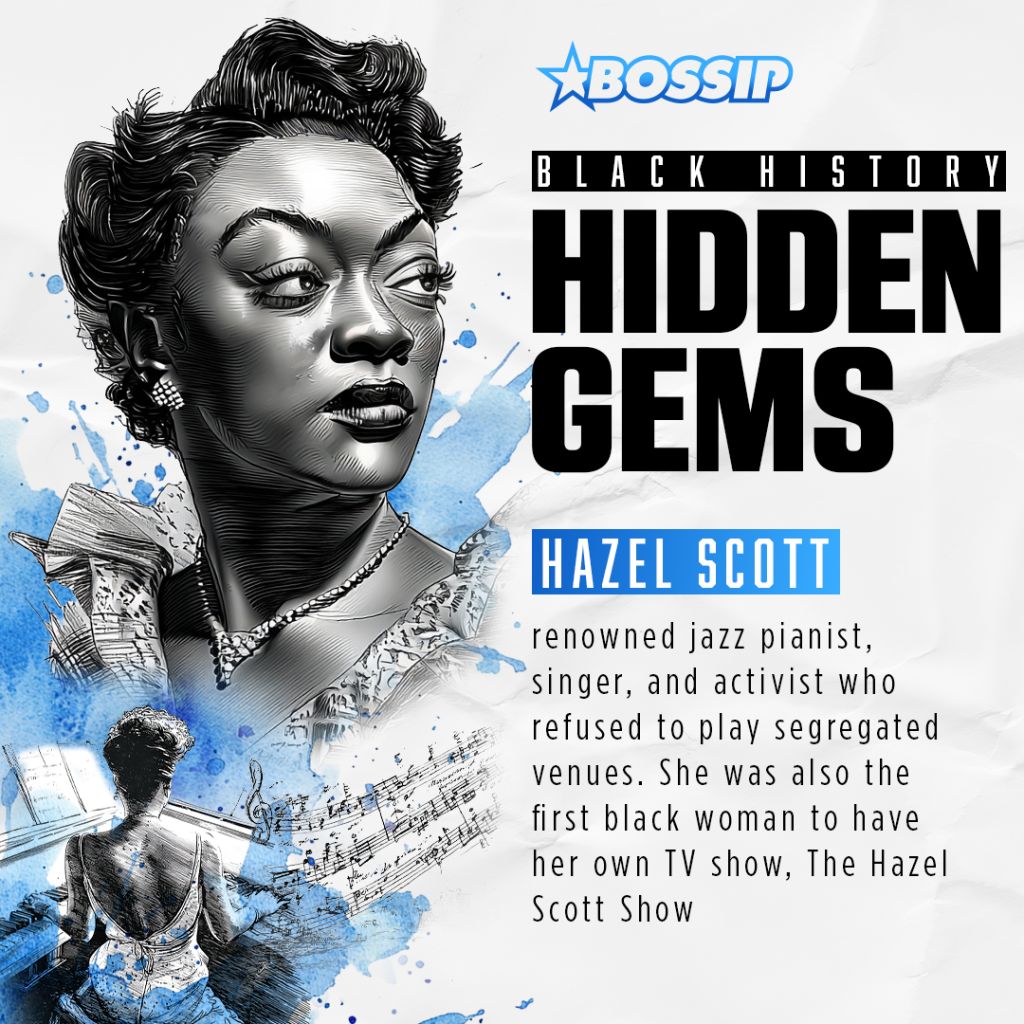
A Piano Prodigy Becomes A Star
Born in Trinidad on June 11, 1920, to West African scholar R. Thomas Scott and classically trained pianist Alma Long Scott, it seems that Hazel Scott’s meteoric rise to the top of entertainment and liberation movements was destiny. By the age of three, she became a local legend for playing piano by ear.
According to PBS’s American Masters, Scotts moved to Harlem, New York, in 1924 at the height of the Harlem Renaissance. Scott’s mother took her to audition at Juilliard at eight, half the prestigious school’s minimum age. She improvised Rachmaninoff to compensate for hands too small to reach all of the keys, convincing Walter Damrosch to grant her a special admission and scholarship. At 13, Scott followed her mother’s musical footsteps to play in Alma Long Scott’s All-Girl Jazz Band.
By 16, Scott hosted her own radio show on WOR, where she flexed complex classical piano performances. She shared the stage with the Count Basie Orchestra and made her 1938 Broadway debut in “Sing Out the News.” During her gig at Manhattan’s Yacht Club, the 18-year-old perfects a signature style to “Swing the Classics” with jazz’s speed and syncopation.
Hazel Scott Finds Her Big Break And Musical Home At The Café Society
At the innovative Café Society, the first desegregated nightclub in the U.S., Billie Holiday gave Scott her big break to replace the “Strange Fruit” singer as headliner. Her star continued rise at one of the hottest and most progressive venues in the country. Scott’s first album, “Swinging the Classics,” became a critically acclaimed and record-breaking success in 1940.
This fame and fortune became leverage to fight for equality as she continued to climb. With fans like Paul Robeson, Sinatra, Frank Sinatra, Duke Ellington, and Eleanor Roosevelt, Scott had the power to demand in her contracts that she never perform for segregated crowds. Scott famously cancelled an Austin, Texas show when she saw the venue wasn’t integrated. “Why would anyone come to hear me, a Negro, and refuse to sit beside someone just like me?” she asked Time magazine.
Breaking Down Barriers In Hollywood
Scott didn’t change when Hollywood came calling. Despite being a newcomer, Scott turned down four film roles as a singing maid. While the industry reduced Black actors to servants, villains, and prostitutes, the triple threat’s contract stipulated she would only play herself. While Hattie McDaniel couldn’t find reprieve from segregation long enough to collect her historic Academy Award, Scott demanded final approval of her song selection and supplied her own elegant wardrobe.
Scott became the first Afro-Caribbean woman in major Hollywood roles like I Dood It (1943), Broadway Rhythm (1944), and Rhapsody In Blue (1945). Big screen success didn’t last long after filming The Heat’s On (1943). Scott and Lena Horne were the only Black stars on an all-white cast, where rampant racism compelled the outspoken advocate to take a stand.
Scott halted production for three days over a performance where Black women dressed in dirty aprons sent their men off to war. She called it unrealistic and demanded a wardrobe true to the pride of her people. She won the battle, but a studio executive vowed that the prolific pianist would never book another film again.
Hazel Scott Makes History With Her Own TV Show & Makes An Enemy Of The U.S. Government
After marrying progressive pastor-turned-New York Councilman Adam Clayton Powell Jr. in 1945, Scott stopped performing at nightclubs and Café Society. The power couple welcomed a son, Adam Clayton Powell III. She went on a 35-week national tour, still demanding forfeiture for any bookings at segregated clubs, including the Jim Crow South. According to PBS, Martin Luther King Jr. later told Scott her performance was “the first time I sat in a non-segregated audience in the south was at one of your concerts.”
In 1950, Scott became the first Black broadcast TV host with the “Hazel Scott Show” on the Dumont Television network. No recordings of her show survived, but it was so popular that it expanded to a national airing three times a week.
That same year, McCarthyism forced Scott to choose between fighting for freedom and newfound success when the “Red Channels” listed her as a Communist. She was one of the few entertainers to insist on testifying before the House Un-American Committee (HUAC) to clear her name.
She denied what she believed were misconceptions based on her association with the Café Society. However, the most damning “Un-American” thing Scott did was defy racism at every turn, including a landmark 1949 lawsuit for discrimination when a Pasco, Washington restaurant refused to serve her. Scott denounced the list of suspected sympathizers, HUAC, and any platform that conceded by participating in the blacklisting.
“The actors, musicians, artists, composers, and all of the men and women of the arts are eager and anxious to help, to serve. Our country needs us more today than ever before. We should not be written off by the vicious slanders of little and petty men,” she bravely said in a 14-page statement.
Once Blacklisting Ends Hazel Scott’s U.S. Career, She Starts Over In Paris
One week later, the network canceled her hit show as sponsors pulled out. Scott left for Europe as blacklisting ruined her U.S career, befriending Black ex-pats like James Baldwin, Josephine Baker, and Dizzy Gillespie. As Scott’s marriage declined, her career revived with a European concert tour. In 1955, she recorded one of the most important jazz albums of the 20th century, Relaxed Piano Moods, with Max Roach and Charlie Mingus.
In 1963, she and James Baldwin organized a demonstration of African Americans at the U.S. embassy in Paris to support the March on Washington. Scott soon returned to the States, only to find Motown and Rock replaced Jazz and Blues.
Scott focused on her son’s growing family and continued to play clubs and concerts. She rapidly recorded three albums in 1979: “Always,” “After Thoughts,” and “After Hours.”
In 1981, Hazel Scott died of pancreatic cancer. In addition to a loving family, she left behind an incomparable legacy of genius, innovation, advocacy, and bravery in the face of overwhelming oppression and injustice. Tragically, too few remember Scott’s name and contributions. Alicia Keys put her back in the spotlight at the 61st Grammy Awards with an homage to playing two pianos at once, like Scott famously did with mesmerizing elegance and ease.
- Black And White And Red All Over: Jordyn Woods Stands Out In All-White Swimsuit During Beachside St Barts Bachelorette Party
- Papa Proof! Footage From Latto’s ‘Big Mama’ Baby Shower Finally Confirms 21 Savage Coupledom
- Sunken Seed-Spreader Nick Cannon Hard-Launches Love Of Trump With Amber Rose, Muva MAGA Defends White People Saying N-Word


